How Often Should You Change Cold Plunge Water? A Simple Care Schedule
Updated · 7 min read · By Steve Gilman, Editor
We may earn a commission from links on this page, at no extra cost to you. Affiliate disclosure.
Key takeaways
- Cold water slows bacteria but doesn't stop it, and it also slows down chlorine. Every plunge needs a cleaning plan.
- Unfiltered ice tubs need fresh water every few days. Filtered, sanitized chiller tubs can often go weeks between changes, depending on use and the manufacturer's instructions.
- Shower before you plunge, keep the lid on, and drain early if the water turns cloudy, smells, feels slimy or won't hold a sanitizer reading.
The short answer
How often you change the water depends mostly on one thing: whether the water is filtered and sanitized.
| Your setup | Typical water change | Notes |
|---|---|---|
| Bathtub or ice bath you fill for one session | After each session | Simplest and most hygienic. |
| Unfiltered tub or barrel (no pump, no filter) | Every few days; at least weekly | Sun Home suggests every 2–5 days for unfiltered setups. Change sooner with daily use or more than one user. |
| Chiller tub with filter, no added sanitizer | More often than a sanitized tub; check your manual | Filtration removes particles but doesn't kill germs on its own. |
| Chiller tub with filter **and** sanitizer (chlorine, bromine, or the manufacturer's approved system) | Every few weeks to a few months | Follow your manual. Sun Home, for example, says every 2–3 weeks for its standard plunge, and says well-maintained filtered and sanitized systems can last 8–12 weeks. |
These are typical ranges, not rules. Your manufacturer's manual comes first, and your eyes and nose come a close second (see the warning signs below).
Why cold water still needs cleaning
It's tempting to think cold water stays clean on its own. It doesn't. Every session adds sweat, skin cells, body oils, lotion and whatever is on your feet. Cold slows bacterial growth, but it doesn't stop it.
Cold also works against you in one important way. Canada's National Collaborating Centre for Environmental Health (NCCEH) notes that cold water slows chlorine's disinfecting action, so you need a stronger sanitizer level or more contact time to get the same effect. In one example it cites, inactivating Giardia cysts with chlorine took about twice as long at 10°C (50°F) as at 20°C (68°F).
The best real-world data comes from shared tubs. The only study the NCCEH found compared ice baths at sporting events in Australia:
- Fixed tanks with recirculating filtration and automatic disinfection: 7 of 8 water samples were free of the bacteria tested for.
- Mobile inflatable tubs with no filtration, chlorine added by hand and only daily draining: 64% of samples tested positive for E. coli/coliforms, Pseudomonas aeruginosa or Staphylococcus aureus.
A home plunge used by one or two people is a much lighter load than a busy event tub. The lesson still applies: filtration plus a steady sanitizer level keeps water clean; hand-dosed, unfiltered water goes bad quickly.
A simple weekly routine
- Shower before every plunge. It's the easiest way to keep the water clean, and it's what public health agencies recommend for shared tubs.
- Keep the lid on whenever you're not in it. It keeps out leaves, bugs and sunlight (which feeds algae).
- Skim debris as soon as you see it.
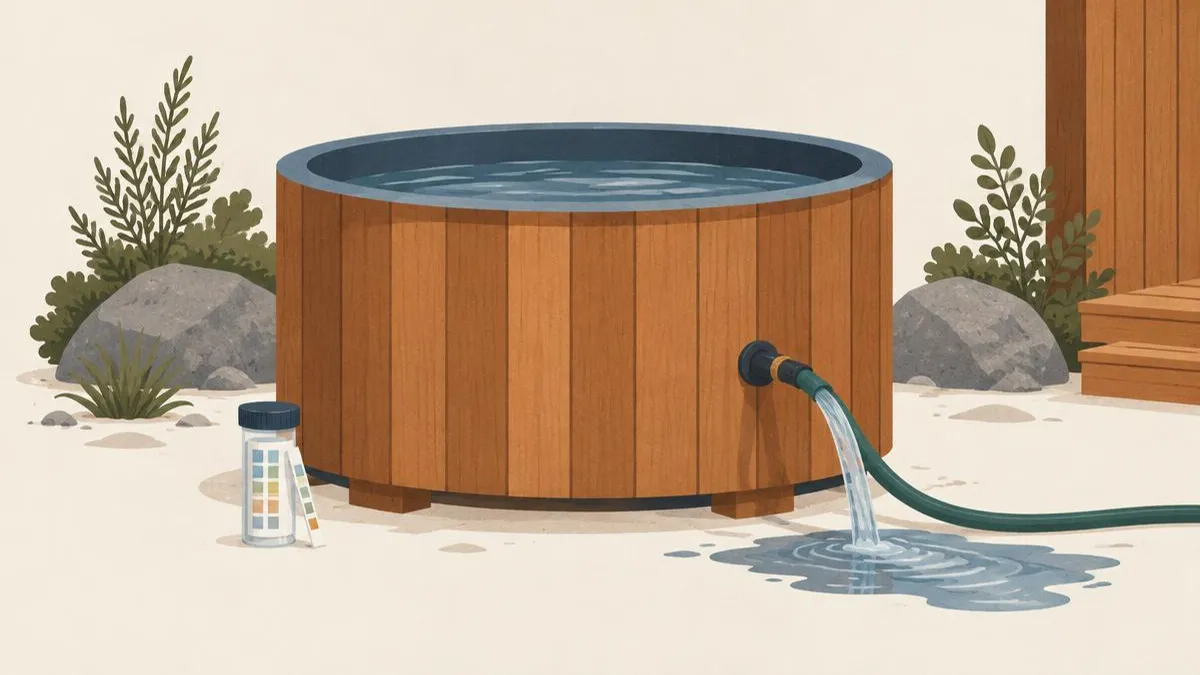
- Test the water weekly if you use a sanitizer (more often with heavy use). Spa test strips are cheap.
- Rinse the filter weekly and replace it on the manufacturer's schedule. A clogged filter cleans poorly and makes the chiller work harder.
- Log your water changes so you're not guessing.
Which sanitizer should you use?
Use the one your manufacturer approves. The wrong chemical can damage seals, pumps and chillers and void your warranty. Here's how the common options compare:
| Option | What it does | Keep in mind |
|---|---|---|
| **Chlorine** | Kills germs and leaves a measurable "residual" in the water. | Works more slowly in cold water. For hot tubs, the CDC recommends free chlorine of 2–4 ppm with pH 7.2–7.8. No equivalent home cold plunge standard exists yet, so follow your manual. |
| **Bromine** | Similar to chlorine, often preferred in spas. | CDC hot tub guidance is 4–6 ppm. Research on bromine at low temperatures is limited. |
| **Ozone or UV** | Treats water as it passes through the system. | Helpful as a secondary treatment, but they don't leave a residual in the tub itself. Public health guidance pairs them with chlorine or bromine. |
| **Hydrogen peroxide** | A popular "chemical-free" option for DIY tubs. | Breaks down quickly. The NCCEH doesn't recommend it as a disinfectant for cold plunge tanks. |
Drain early if you notice any of these
- Cloudy or milky water
- A musty, sour or "swampy" smell
- Slimy walls or a film on the surface (biofilm)
- Visible algae (green tint or spots)
- A sanitizer reading that won't stay in range
- Anyone in the household has an open cut, rash or stomach bug (they should skip plunging until healed)
How to do a full water change
- Turn off and unplug the chiller and pump before draining.
- Drain the tub, and drain the filter housing and chiller if your manual says to.
- Wipe down the inside with a soft cloth and a cleaner your manufacturer approves. Avoid abrasive pads that scratch surfaces and give bacteria somewhere to hide.
- Clean or replace the filter.
- Refill with clean tap water, restart the system, and add sanitizer according to the manual.
Draining a few hundred gallons takes a while, so plan where the water will go. Never drain chlorinated water into a storm drain if your local rules prohibit it.
The cost side
Water itself is cheap. Filters are not: depending on the brand and how often you change them, replacement cartridges can cost as much each month as the electricity to run the chiller. Our cold plunge running cost guide breaks this down.
Sources
- National Collaborating Centre for Environmental Health (NCCEH): Cold plunge tanks — considerations for environmental public health (2024)
- CDC: Hot tub user tips (disinfectant and pH ranges)
- NACCHO: Cold plunge pools — public health considerations
- Sun Home: How often should you change your cold plunge water?
- Sun Home Help Center: How to maintain your cold plunge
- Sun Home: Cold plunge replacement filter (recommended replacement interval)
Frequently asked questions
Can I leave water in a cold plunge for a month?
Only if it's filtered and sanitized and your manufacturer says that interval is fine. Unfiltered tubs need fresh water every few days to a week.
Do I need chemicals in my cold plunge?
Filtration alone removes particles but doesn't kill germs. Most filtered home plunges use a sanitizer the manufacturer approves, sometimes alongside ozone or UV. If you use no sanitizer at all, change the water much more often.
Why does my cold plunge water smell?
Usually it's organic buildup from sweat and skin oils, a dirty filter or biofilm in the plumbing. Drain, clean the tub and filter, and refill. If it keeps happening, change the water more often and check your sanitizer.
Is hydrogen peroxide safe for a cold plunge?
Some people use it in DIY tubs, but it breaks down quickly and public health reviewers don't recommend it as a cold plunge disinfectant. Use whatever your manufacturer approves.
How often should I change my cold plunge filter?
Follow your manufacturer. Sun Home, for example, recommends replacing its standard filters every 2–4 weeks depending on use; rinse the filter between replacements.
Related articles
Cold Plunges · guide
Cold Plunge Buying Guide (2026): Chiller vs. Ice, Temperature, Size and Safety
Thinking about a home cold plunge? How to choose between a chiller and an ice tub, what temperature you actually need, what it costs, and how to stay safe.
10 min read
Cold Plunges · guide
How Much Does a Cold Plunge Cost to Run? Electricity, Filters and Ice (2026)
What a home cold plunge really costs per month: chiller electricity, filters, sanitizer and ice, with worked examples and a free calculator.
8 min read
Cold Plunges · guide
Using a Cold Plunge Outdoors in Winter: Freezing Temps, Chillers and Safety
Can you keep using an outdoor cold plunge in winter? What manufacturers say about freezing temperatures, how to winterize, and staying safe in the cold.
7 min read
Contrast Therapy · guide
How to Set Up Contrast Therapy at Home: Sauna + Cold Plunge Planning Guide
Planning a sauna and cold plunge at home? Layout, space, power, budget and a sensible beginner routine for home contrast therapy, plus the safety basics.
8 min read